Research
Artificial Intelligence and the Evolving Standard of Care in Dentistry: Clinical Evidence, Regulatory Landscape, and Medicolegal Implications
· Dr. Volodymyr Kachmar
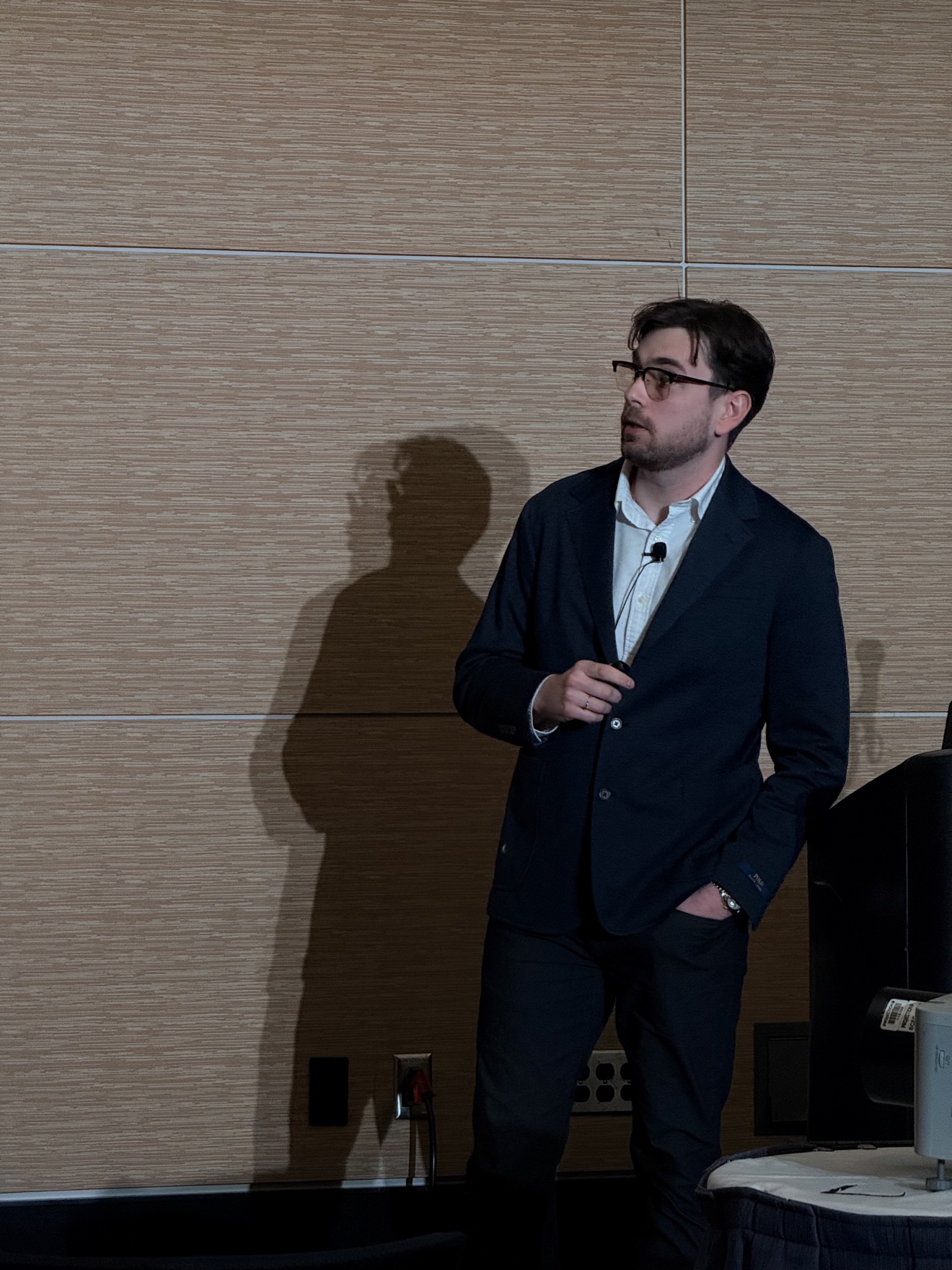
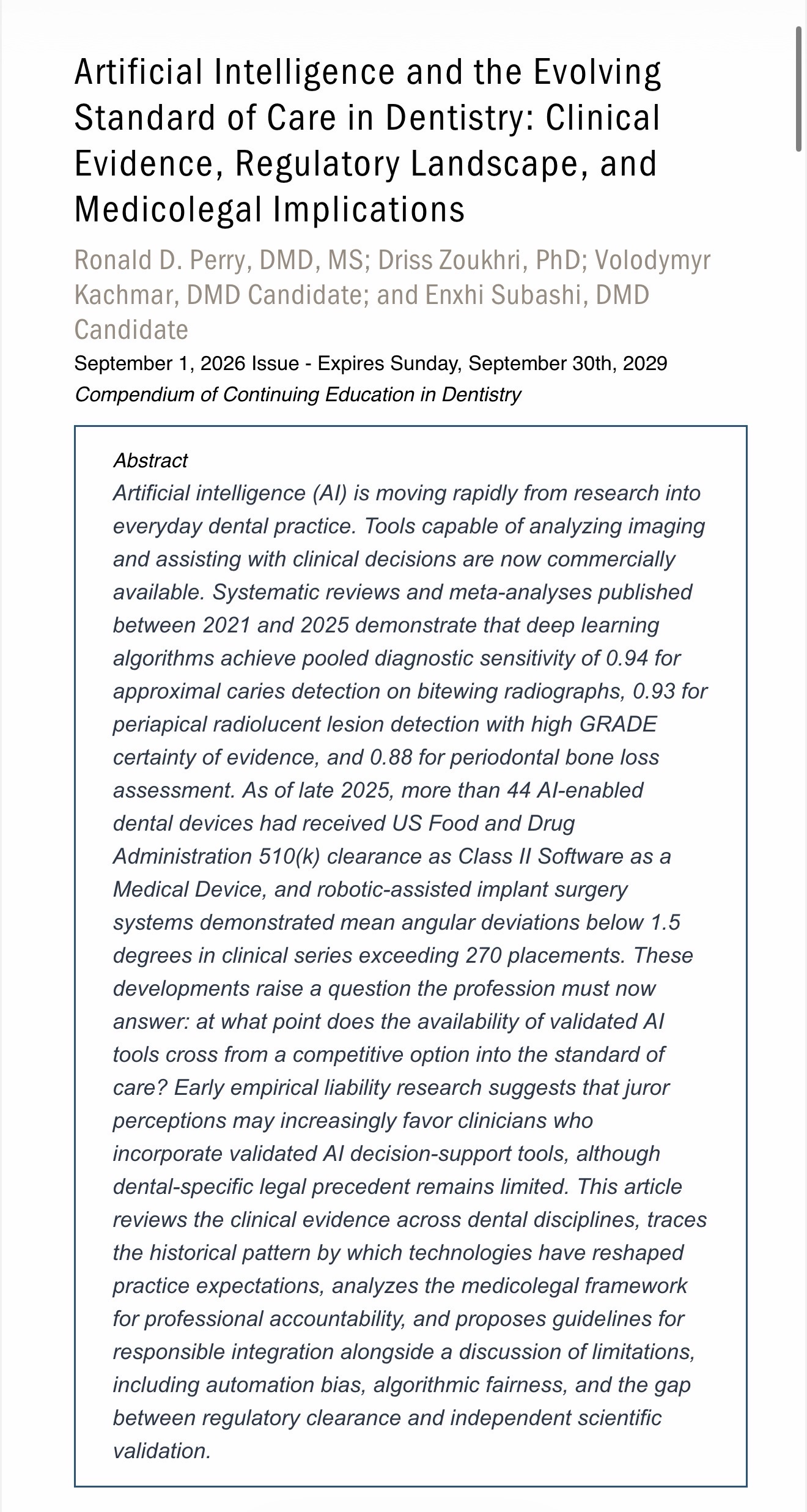
This week, a new article I co-authored was published in Compendium of Continuing Education in Dentistry. I worked on it alongside Professor Ronald D. Perry, DMD, MS, and Professor Driss Zoukhri, PhD, both of the Department of Comprehensive Care at Tufts University School of Dental Medicine, and my colleague Enxhi Subashi, DMD Candidate. It is a rigorous, peer-reviewed piece — and, for me, one of the most valuable collaborations of my professional path so far.
The article asks a question dentistry can no longer treat as theoretical.
The question at the center of the article
Consider a scenario that is no longer hypothetical: a dentist reviews a routine bitewing series and reads it as unremarkable. Months later, the patient returns in pain — the cause is an interproximal lesion that was subtly visible on the earlier radiographs. At the time of that examination, an FDA-cleared AI caries-detection tool was commercially available, and published meta-analyses reported pooled sensitivity of 0.94 for approximal lesions. The dentist did not use it.
Does that decision constitute a departure from the standard of care?
That is the question our article puts at the center. The standard of care is not a fixed line — it represents what a reasonably competent practitioner would do under similar clinical circumstances, and it evolves as evidence and capability advance. American healthcare jurisprudence recognized this principle long ago: in the 1974 case Helling v. Carey, the Washington Supreme Court held that reasonable prudence, not mere professional custom, defines the standard when a simple, accurate diagnostic test is available. Dentistry applies this principle with its own nuances. But the logic stands: when validated technology exists, choosing not to use it becomes harder to justify.
What the clinical evidence actually shows
The article reviews AI applications across dental disciplines, and the numbers are difficult to ignore. For approximal caries detection, a meta-analysis of 21 studies reported pooled sensitivity of 0.94 and specificity of 0.91, with AI recommended as a first-step screening tool subject to clinician verification. For periapical radiolucent lesions, pooled sensitivity reached 0.925 with a high certainty-of-evidence rating. In CBCT interpretation, AI-aided clinicians achieved significantly higher diagnostic sensitivity than unaided clinicians (0.854 vs. 0.767) across 24 dentists — direct evidence that AI augments rather than replaces human performance.
The pattern holds elsewhere: pooled sensitivity of 0.88 for periodontal bone loss detection; automated cephalometric landmark identification with a mean error of 1.39 mm — below the clinically accepted 2 mm threshold — completed in under a minute versus 15 to 20 minutes of manual tracing; reliable AI segmentation of the mandibular canal in 104 patients; robotic-assisted implant surgery with mean angular deviation below 1.5 degrees and depth deviation below 0.2 mm across 273 implants. The evidence base is real, broad, and growing fast.
FDA clearance is necessary — but not sufficient
As of late 2025, more than 44 AI-enabled dental devices had received FDA 510(k) clearance, with 18 clearances in 2025 alone — approximately 41% of all dental AI clearances ever issued. Nearly all are Class II Software as a Medical Device.
But our article draws a critical distinction: FDA 510(k) clearance establishes substantial equivalence to a predicate device and basic safety. It does not establish the level of independent clinical evidence typically required before professional organizations recommend widespread adoption. Most published performance evidence for cleared products still originates from manufacturer-sponsored research. Clinicians evaluating these tools must look beyond the clearance itself — independent, peer-reviewed validation is what supports confident clinical deployment.
The medicolegal reality most clinicians are not ready for
Liability is the dimension of this transition least familiar to most practicing dentists — and the most consequential. Researchers have described a dual-sided exposure: a clinician may face liability for relying on AI recommendations he or she cannot fully explain, yet may simultaneously face exposure for ignoring available tools that could have prevented patient injury.
The most striking empirical evidence comes from a jury-simulation study with 2,000 US adults. Participants evaluated cases in which a clinician either followed or rejected an AI recommendation. Accepting a standard-care AI recommendation measurably reduced perceived liability — while rejecting AI advice provided no corresponding protective effect, even when the clinician's independent judgment proved clinically correct. Dental-specific case law remains sparse, which is itself a significant finding: the profession is operating in a narrow window where thoughtful guidelines, education, and organizational statements can still shape how courts will evaluate dental AI claims.
What this collaboration taught me
I am honored to have worked on this article with Professor Perry, Professor Zoukhri, and Enxhi Subashi. Peer-reviewed work at this level is a discipline of its own: every claim must carry its evidence, every number its source, every conclusion its limits. It demanded a standard of rigor that stays with you long after the manuscript is submitted.
What I carry from this experience is not enthusiasm for technology itself. It is a clearer understanding of the responsibility that comes with it. AI does not remove the clinician's judgment — it raises the bar for what informed judgment requires.
Where the profession goes from here
The article proposes practical guidelines for responsible integration: AI should augment, not replace, clinical judgment, with the practitioner retaining final responsibility; AI-generated analyses should be documented in the clinical record; only appropriately cleared systems should be used, with scrutiny of independent validation; clinicians should invest in AI literacy through continuing education; and the profession should advocate for equitable validation across diverse patient populations, so AI narrows rather than widens oral health disparities.
Our conclusion is measured and deliberate: AI has not yet fully redefined the dental standard of care — only about 35% of US dentists have integrated AI tools — but the trajectory is clear. The profession has a narrow window to shape this integration responsibly, ensuring better patient outcomes while preserving clinical judgment and professional accountability. That window will not stay open indefinitely.
The full article is available in Compendium of Continuing Education in Dentistry: https://cced.cdeworld.com/courses/23674-artificial-intelligence-and-the-evolving-standard-of-care-in-dentistry-clinical-evidence-regulatory-landscape-and-medicolegal-implications
If the question of AI and professional responsibility is on your mind too — as a clinician, educator, or researcher — I would value the conversation. This is one of those moments where the profession's voice matters more than any single technology.
Professional-use notice: This article is intended for licensed dental professionals and dental students under appropriate supervision. It does not replace diagnosis, treatment planning, informed consent, clinical judgment, manufacturer instructions, or applicable regulatory requirements.